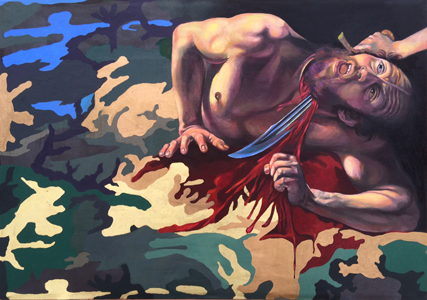
GIANCARLO IMPIGLIA Born in Rome, Italy in 1940, Giancarlo Impiglia studied at the Liceo Artistico and the Accademia di Belle Arti di Roma and completed his studies at CIAC, the Italian Center of Cinematography. In the early 70s he moved to New York where he is still living and working. His signature style is identifiable around the world, and his work poses as a powerful commentary on social, political, and economic contemporary culture. Impiglia is the opposite of a minimalist: he is a maximalist and his work “talks” to civilized art appreciators. He stands on the shoulders of the Italian Futurists, recalls the flourishes of Art Nouveau, celebrates the curving geometry of Art Deco and integrates the concept of Cubism. His technical skill underpins all and frees him to indulge an appetite for complexity. Besides featuring in various prominent museums, publications, and private collections, Impiglia’s work has been exhibited in countless galleries all over the world. One of his works most notably was used as an official advertisement for Absolut Vodka, and his large murals can be seen in the lobby of 99 John Street in Lower Manhattan as well as gracing the walls of all of Cunard’s cruise liners, where they echo the Roaring ‘20s and ‘30s and the Golden Age of travel. Free from the fashions of the contemporary art market, Impiglia continues to demonstrate his unique artistic identity, his signature style always unfolding into new visions. His most recent works comment on sociopolitical issues, in particular acting as a testimonial against violence and human degradation.
EMILIANO TOLVE Born in 1940 in Potenza, Italy, Emiliano Tolve is an author, poet, and painter who studied at the Liceo Artistico in Rome and whose works are a part of important private collections in Europe. The Galleria is proud to exhibit his work for the first time in America.
KAREL APPEL Karel Appel was born in Amsterdam in 1921. Influenced early on by Picasso and Matisse, Appel made a great stir in his home country when he founded the Cobra avant-garde group (1948-51), emphasizing expressive compositions inspired by folk and children’s art. Eventually he moved to France where he established himself as a foremost artist, with numerous solo exhibitions at places like the Palais des beaux-arts as well as painting numerous murals for public buildings. In the ‘80s he collaborated with the American poet Allen Ginsberg, and before his death in 2006, further solo exhibitions of his work took place at the Museum Boijmans Van Beuningen, Rotterdam (1982), Castello di Rivoli–Museo d'arte contemporanea, Turin, Italy (1987), National Museum of Art, Osaka (1989), Stedelijk Museum (1998, 2000, and 2001), and Cobra Museum voor Moderne Kunst, Amstelveen, Netherlands (2001).
MILES DAVIS Born in 1926, jazz legend Miles Davis is not as well known for his artwork as he is for his music. That is not to say his paintings are in any way inferior. On the contrary, when he picked up a paintbrush in his late 50s, Davis demonstrated a keen understanding of color and balance and applied the same concentration and determination with his abstract, muscular artistic compositions as he did with his musical ones. His resulting paintings are full of energy, musical notes permeating the rich colors.
SALVADOR DALI Born in Figueres, Spain in 1904, Salvador Dali needs little introduction. A surrealist whose imaginative art has struck viewers for the good part of a century, Galleria Della Lupa is proud to exhibit his “Apollinaire Suite.”
FRANCISCO ZUNIGA Internationally acclaimed sculpture and printmaker Francisco Zuniga was born in Costa Rica in 1912. His father, a sculpture of religious figures, exposed him early on to the art world. Noticing his talent, Zuniga was sent to attend the School of Fine Arts in San Jose before eventually moving to Mexico City in 1936. His work embraces the Mayan composition, portraying elements of humble Mexican society along familial themes such as maternity, and his large-proportioned native figures form the best example of the Mexican political modern style. By the time of his death in 1998, Zuniga was well established as one of the most prominent sculptures of the 20th century.
CHARLES LABORDE Prolific illustrator and writer Charles Laborde was born in Buenos Aires in 1886 to French parents. Following his studies at the Academie Julian and at the Ecole Nationale des Beaux-Arts in Paris, Laborde’s career became one focused on contribution to numerous important publications of the time including Le Rire, L’Assiette, The Red Laugh, the French Courier, the Gazette du Bon Ton, as well as magazines such as Vogue and Vanity Fair, where his stylized figures and caricatures evoked and satirized daily Parisian life.
ALBERT MENTZEL FLOCON One of the most innovative and versatile engravers of the 20th century as well as accomplished painter and experimenter of perspective, Albert Mentzel Flocon was born in Kopernick in 1909. He attended the Dessau Bauhaus from 1927 to 1930, studying under Albers, Klee, Kandinsky, and Oscar Schlemmer. In 1933 he left Nazi Germany for France where he worked at “La Tecnique Publicitaire” under Victor Vasarely. A savant and avante-garde, Flocon’s spent his post-war career focusing on expanding artistic horizons through both theory and practice.
JEAN-EMILE LABOUREUR Born in Nantes in 1877, Jean-Emile Laboureur was a influential painter, engraver, etcher and lithographer whose works were influenced by the primal nature of Paul Gauguin and the dynamic nature of Cubism. A student of the Academie Julian and founder of Les Peintres-Graveurs Indépendants, ultimately, his style evolved into something of its own, modern, stylized, and at times idyllic images not dissimilar to the elegant lines of Art Deco.
CAMILLE COROT A true Romantic like Turner and Constable, Camille Corot’s plein-air landscape paintings form very much anticipated the advent of the Impressionists. Born in Paris in 1796, Corot was from a prosperous bourgeois family, which allowed him to pursue his passion for painting. This passion led him several times to Italy, where the landscape and classical remains had a resounding impression on his psyche, contributing to his poetic, neoclassical visions. Corot’s influence on 20th century art is resounding, and his works can be seen in prestigious museums like the Met, the Musee D’Orsay, and the Louvre. |
Copyright 2011 @ www.GalleriaDellaLupa.com. All rights reserved |